




Photographs can be seen in our Volvo Gallery
The world's most expensive dummies save lives
11 August 2009
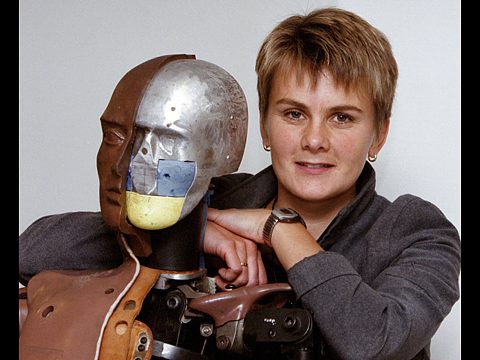
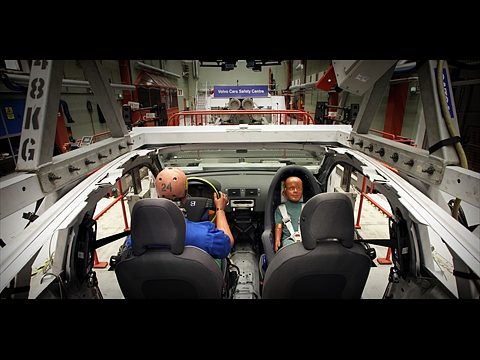
The Crash-Test Dummy family does invaluable work in the development of tomorrow's ever-safer cars. The dummies may cost anything up to 1.5 MSEK, and at Volvo Cars there are more than 100 members of this tough family.
The crash-test dummy is involved in all research into and development of car safety. It represents the human being in the car and using the dummy, Volvo Cars' safety experts find out how a real human being is affected in a collision.
"It's very difficult to develop crash-test dummies. The aim is to create as close a resemblance to a real human being as possible. At the same time, however, it has to be a tough tool. One highly successful example dates from the 1990s when Swedish researchers developed a crash-test dummy for rear-end collisions. This dummy, which features a very detailed spine, is now used the world over to evaluate whiplash injuries," says Lotta Jakobsson, biomechanics and technical specialist with the Volvo Cars Safety Centre at Volvo Cars.
At Volvo Cars, the Crash-Test Dummy family is structured around 19 family members - eight adults and 11 children. The smallest is an infant weighing 3 kilograms.
There are family members of different configurations and for different purposes, making a grand total of more than 100 dummies. The family is so large because it is necessary to include both children and adults of different ages, sizes and to cover different collision scenarios.
Advanced measurement tool
The first crash-test dummies were developed in the mid-sixties and were fairly simple in their design. Today there are many different types of crash-test dummy - European, American and individual designs for specific purposes such as frontal, rear or side collisions.
In order to aid standardisation of crash-test dummies the world over, researchers are now working on the development of a standardised side-impact dummy. This work has gone on for more than 10 years and underlines just how advanced a measurement tool a crash-test dummy is.
Crash-test dummies smash into walls every single day without making a fuss and they can undergo about five collisions before it is time for rehabilitation - or recalibration as it is known in technical jargon.
Dummy inspections needed
During the calibration process, the dummies are inspected and adjusted to prepare them for new tests. Broken parts are replaced and various measurement parameters are tested. It is important that the dummies behave consistently in each and every test, which is why they are calibrated so regularly.
Thanks to the fact that it is possible to repair the dummies and replace parts as needed, they are almost indestructible. The true veterans at the Volvo Cars safety centre are more than 30 years old and they have been involved in hundreds of serious collisions. This just highlights their toughness.
Every collision is preceded by days of precise preparations as the dummies are set up in a special workshop.
There are about 100 measurement points on each dummy, and these are used to register the forces exerted on the dummy's head, neck, spine, chest, hips and legs during the collision sequence.
Detailed studies by engineers
The information provided by the dummies is stored on computer and each test is followed by an evaluation. This allows the engineers to study in detail how much force the dummy had to withstand and how the forces were distributed during the collision.
Thanks to biomechanical research, the engineers can determine how much physical stress various parts of the human body can withstand before suffering serious injuries.
Today, researchers rely increasingly on virtual crash-test dummies which only exist in computer programs. With virtual dummies, it is easier to alter weight and height and thus make it even more possible to resemble people of various builds.
Having said that, the conventional, battle-hardened crash-test dummies are going to live on for a long time to come, working side by side with their virtual cousins in the computer.
Legal | Privacy | Contact Us | Search | Site Map
Volvo Owners' Club Limited® 1962-2024