
Crusie Control on Volvo 700, 900 and 90 Series
Cruise Control Won't Work or Incorrectly Disengages/Re-engages: Diagnostics
Cruise Control Surges: Worn Servo
Cruise Control Onboard Diagnostic Codes
Cruise Control Installation Instructions for 740 Cars
Cruise Control Won't Work or Incorrectly Disengages/Re-engages
Vacuum Diagnostics:
Basic Diagnostics. My cruise control stopped functioning. Where do I start? [Jay Simkin] When cruise control malfunctions: (a) vacuum pump and cruise control module not likely to be a source of trouble; (b) throttle servo (black rubber bellows) and vacuum lines merit a quick look; (c) turn signal wiring and cruise control switches on the turn signal stalk should be checked first, as it is easy to access. [Vladimir Ferdman]
- Check the vacuum system integrity first. If this checks out proceed to 2. Otherwise find the source of a leak in the vacuum system. Mine was in the brake pedal switch, which I guess is common. I found my vacuum pedal switch/valve to not hold vacuum.
- Perform OBD tests regarding the cruise control. The OBD system is very good and will often pinpoint the problem.
- If all the above checks out good, then test the vacuum pump.
- A very last resort is to question the control module, but these rarely fail.
Vacuum Servo Diaphragm Bellows and Lines. [John Randstrom] I have found that the vacuum servo diaphram that pulls the throttle open can spring a leak. I usually check these first, along with all of the electrical connections and vacuum lines and valves that are mounted to the brake and clutch pedal brackets. Check all the vacuum lines and the servo with a Mityvac tester and if they hold a vacuum, you have no leaks. If these valves do not seal with the pedals in the rest position, the vacuum will be bled from the servo and the cruise will not engage. ]Philip Baugh] I recently had the cruise control go out on my 1994 944 and 945, so I thought I would share how I fixed each. Using my mighty vac I traced the problem on my 944 to a pinhole leak on the cruise control bellows under the hood. I cleaned the rubber bellows and applied a small inner tube patch. [Editor] The bellows can leak where it contacts the edge of the throttle position switch and develops a wear groove.
Pedal Switch. Earlier 740s have a brass brake cruise control cutoff switch near the brake pedal arm that can reputedly be sealed using Teflon tape or grease. Later 740/940 cars have the pictured Hella switch. Either one can leak, stopping the cruise control and causing a system vacuum leak. On my 945 I traced the problem to a leak in this valve (Volvo p/n 1367159 or VW p/n 811907343B). I was able to 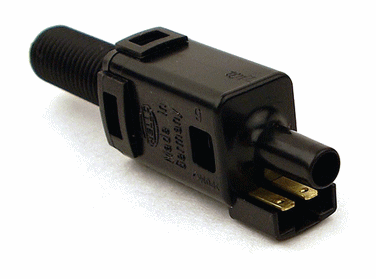 take the switch apart and replace the "O" ring with an extra from a pack of o rings left over from some AC work. [Vladimir Ferdman] In my case, a cruise control unable to hold speed was caused by a faulty pedal switch. I have actually been able to service it. It has
a little o-ring and the plastic plunger that goes through the white O-ring
sealing the switch. When the pedal is pressed the plunger is released
and breaks the seal with the o-ring. The O-ring looked like new when I
picked it out of the switch. Not cracked or damaged. Same with plunger.
So, I decided that it just needed a bit of grease to re-invigorate the
sealing properties. I tried it and it worked great. Looks like the
switch is meant to be serviced. It is nicely made by Hella and meant to be opened (use a piece of aluminum wire pressed beneath the prongs to hold them up to take it apart). Possibly had some grease in there
that dried up. I used food-grade petroleum grease. It is not very stiff,
but is pretty sticky. Hopefully it will hold up. If not I'll try white
lithium. O-Ring: Replace with a square or quad cross section O-ring in Buna-N material with size AS568-008 (ID=4.65mm; CS=1.7mm) from ORingsandMore.com ($5 for a package). Loose Hose Connections. [John Sargent] Check the vacuum hose connections under the hood.The hose ends stretch with age and lose their grip on the hose barbs. The hose ends also split and leak. Even a small split right at the hose end will cause the cruise to fail, as will a loose fit on the fitting barb.
take the switch apart and replace the "O" ring with an extra from a pack of o rings left over from some AC work. [Vladimir Ferdman] In my case, a cruise control unable to hold speed was caused by a faulty pedal switch. I have actually been able to service it. It has
a little o-ring and the plastic plunger that goes through the white O-ring
sealing the switch. When the pedal is pressed the plunger is released
and breaks the seal with the o-ring. The O-ring looked like new when I
picked it out of the switch. Not cracked or damaged. Same with plunger.
So, I decided that it just needed a bit of grease to re-invigorate the
sealing properties. I tried it and it worked great. Looks like the
switch is meant to be serviced. It is nicely made by Hella and meant to be opened (use a piece of aluminum wire pressed beneath the prongs to hold them up to take it apart). Possibly had some grease in there
that dried up. I used food-grade petroleum grease. It is not very stiff,
but is pretty sticky. Hopefully it will hold up. If not I'll try white
lithium. O-Ring: Replace with a square or quad cross section O-ring in Buna-N material with size AS568-008 (ID=4.65mm; CS=1.7mm) from ORingsandMore.com ($5 for a package). Loose Hose Connections. [John Sargent] Check the vacuum hose connections under the hood.The hose ends stretch with age and lose their grip on the hose barbs. The hose ends also split and leak. Even a small split right at the hose end will cause the cruise to fail, as will a loose fit on the fitting barb.
Split Hose or Misadjusted Switches. [Response] Most common problem that I have seen is either split or disconnected vacuum hose, or mis-adjusted brake switch (at the pedal) or clutch switch (if manual tranny). Sometimes it is simply that the brake or clutch pedal is not fully returning - try lifting up on the pedal with your foot while driving and see if you can engage the cruise. In addition to the vacuum switch, check for operation of the brake light switch. I seem to remember that the vacuum switch will disengage the cruise simply by releasing the vacuum from the unit, but the brake light switch must activate in order to release the control unit signal. If you are just tapping the brake lightly to disengage the cruise (as I often do), but not activating the brake light switch, then it may simply re-engage as soon as vacuum is applied again.
Applying Vacuum to Locate Leaks. [Response] Pull hose loose at "T" fitting aft of throttle servo or at the vacuum pump . Apply vacuum (suck on it, but make sure no one's watching) to fitting with hoses that run down to pump and into car to brake pedal defeat switch. Watch the rubber servo bellows which should collapse and hold vacuum. If leaks are detected here then find split hose or go inside and find pedal switch fault. Or closely inspect the servo for splits or tears. The likelihood of electrical trouble is far lower than having a hose split or a leaking servo. See below for information about the vacuum pump. [Editor] On 940 cars, an easy vacuum system test is to disconnect the vacuum line at the back of the bellows on the throttle. Using a Mityvac, test the bellows for leaks. Then apply vacuum to the line you disconnected while placing a finger on the white bottom air vent on the vacuum pump. The system should hold vacuum. Have a helper press the brake pedal which should release the vacuum. Remember to replace any vacuum hoses you might have disconnected.
Mechanical Diagnostics:
[Response: Robin Roemisch] My 740's cruise control throttle cable had come unwrapped from the spool. Its easy to catch if you're messing around the throttle body, and it comes off rather easily. Just wrap it back around and that should do it
[Response: Gene Stevens] In addition to the list John noted, two things I'd check first are brake light operation (#5 on his list), as every manufacturer uses them for a ground circuit path to the cruise controller, AND the item that made me a little crazy on mine... There's a vacuum release valve on the brake pedal that can bind a bit with age. Hold the brake pedal up with one foot while you engage the cruise control. If it now works properly, the release valve my be slightly open. Mine would vary speed on certain days, opposite of the way you'd expect. Flat ground would occasionally lose about 1 MPH per minute and settle in about 8-10 MPH below set speed. Start going uphill, and the car accelerated back to the set speed, and maybe/maybe not, do the 1MPH/minute thing again after getting level again. Going downhill would cause a faster drop in speed (odd, huh) and creep back up on level ground. The final answer was that the tilt of the car going up and down hills changed the effective weight on the brake pedal. Lift the pedal, and rock solid speed every time.
[Response] There is a separate switch with a vacuum line attached for the cruise. If the car is manual tranny, the car would have two switches, one for each pedal. If the switch adjustment is marginal, i.e., there is not a definite "off", then the switch needs to be adjusted. It is adjusted the same way as the brake switch.
Electrical Diagnostics:
[Inquiry] My cruise control in my 1990 740 has failed. Vacuum hoses are fine. How do I test internally for the problem related to the push button control button attached on the turn signal lever?
[Response: John Sargent] Before you start checking the switch, lets do the easy electrical circuit tests.
- Is the yellow speed signal wire connected to the back of the speedometer? [Editor] Depends on model: could be orange/green etc. Check the wiring diagram.
- Are the brake and clutch switches properly adjusted and carrying electricity? The brake and clutch switches get power from the brake light switch. Terminal 3 at the control unit should have power from the brake and clutch switches.
- Is fuse # 10 good? Is there electricity to the unit? Terminal 1, blue-red.
- Are both brake lights working? The cruise control supervises the stop light circuit, and if the stop lamps are bad, or the lamp failure relay dies, the cruise control will not work. [Note from John Sargent] There is a reason for this. The people who designed the cruise control did not want the cruise control to work if there was no input from the brake system to shut the cruise control off when stopping. The cruise control imparts a very small voltage to the brake light circuit. A very small amount of current flows (this is referred to as a supervised circuit) if the circuit is connected. A failure of the bulb failure sensor can have the same effect as having both stop lamps burnt out. As a result, if both your brake lights and your cruise control fail, then take a hard look at the bulb failure sensor.
- Check the wiring connections to the vacuum pump. Pull the hose off the vacuum pump and suck on it. The servo should operate the throttle.
- Is the turn signal unit plugged in? Remove the covers behind the steering wheel and inspect the electrical wiring for breaks. See the FAQ section under "Instruments" if you need to replace the stalk.
- Is the control unit plugged in? The control module is on the left side, under the driver's side kick panel
- Terminal 1 of the switch carries power to terminal 2 of the switch in the On position. Check for +12V at the control unit connector at terminal 11 (Blue-Orange) when the switch is "on" and ignition "on". Or check resistance between terminals 11 (Blue-Orange) and 3 (Orange-Black) which should be infinite in all but "On" or "Resume".
- Terminal 1 of the switch carries power to terminal 4 of the switch when the speed button is pushed (momentary contact). Check for continuity at the control unit connector between terminal 6 (Blue-Green) and terminal 11 (Blue-Orange) when "Set" is pressed and cruise is "on" or "resume" In any other position (Cruise off and Set pressed or Cruise On and Set is left untouched) check resistance which should be infinite.
- Check the brake/clutch vacuum switch electricals by disconnecting the connector and measuring resistance between the switch pins. This should be "0" when the pedal is Up and infinite when pedal is pressed more than 8 mm.
Brake/Clutch Pedal Switches:
[Editor] There are two cruise control switches on the brake pedal: an electrical on-off brake light switch and a brake valve/switch. If you have a manual transmission, this latter will also be on the clutch. The brake light switch cannot be adjusted and can merely be tested for continuity ("on" when the pedal is depressed more than 8mm as above).
The brake vacuum valve should normally be closed and must not leak when the pedal is up. The brake valve comes in two varieties: an older style with a threaded plunger and a newer style with internal plastic catches on the plunger. With the pedals up, the valve is activated, the spring is compressed, the switch is on, and the vacuum valve is closed. The older brake/clutch valve can be adjusted (to about 1 to 1.5mm play between the plunger and the pedal arm) by removing the connectors and turning the valve to the correct play. The newer one has plastic catches in the plunger that hold it correctly: if these fail, replace the valve. Leaks in either valve or at the couplings require replacement or repair as noted above. [Vladimir Ferdman] I found my vacuum pedal switch/valve to not hold vacuum. Removing the switch and disassembling it revealed the o-ring not fitting the plunger snugly. I wrapped two layers of teflon tape on the plunger and reassembled. This fixed the vacuum problem. I then retested and the vacuum held.
Vacuum Pump:
[John Sargent] The cruise control on 940s does not use engine vacuum but rather a vacuum pump.[Vladimir Ferdman] Apply 12V to the bottom terminal and GND to the middle and top terminals
at the same time. This should activate the pump and the vacuum control
valve at the same time and cause the servo at the throttle to contract. If
the GND is removed from the middle, but left on the top terminal the servo
should stay contracted and hold vacuum when the pump is off.
[Al Sichelstiel] Odd occurrence requiring a lot of diagnostic work: the cruise system would initially engage then disengage, as though a vacuum leak or a bad switch were at fault. The cruise would momentarily engage pulling the diaphragm into operation then lose vacuum almost immediately. After much diagnostic work, we found that there is a pressure switch inside the vacuum pump assembly that measures the vacuum level and bleeds off or increases the vacuum as needed. That switch in the pump assembly failed and was dumping vacuum at almost the instant the system engaged. Swapped out the vacuum pump assembly and it worked fine.
Speedometer:
[Editor] When the cruise in my son's 95 940 failed, I performed the diagnostics
thanks to the OBD unit under the hood. It returned "no signal from speedometer". The speedometer and odometer were working fine. I tested the output from the speedo using a multimeter and it "appeared" to be working. After making sure everything else was working, I finally replaced the speedometer and cruise returned to normal.
It so happens that the speedometer receives a sine wave signal from the rear axle sending unit and converts this into a square wave, with frequency proportional to rear wheel velocity, to serve as a the input into the cruise control computer. If this does not happen, no cruise control. I do not have an oscilloscope which would have made quick work of this diagnostic.
Anyway, if your cruise dies and you get this diagnostic report while your speedometer appears to be working fine, consider that the internal wave conversion might have failed. This means a replacement speedo.
Cruise Control Surges: Worn Servo.
[Inquiry:] What is the fix for surging with the cruise control ON. It tends to fluctuate 2-4 mph in level driving conditions. Real annoying.
[Response: Abe Crombie] Look closely at the servo on the throttle housing that tugs the cable wrapped around the throttle spool. This can get a hole worn in it and the vacuum level that keeps throttle positioned evenly is impossible to maintain. Try repairing with a bicycle tube tire patch.
Cruise Control Onboard Diagnostic Codes.
[Editor] Later LH2.4 cars employing two diagnostic modules can directly read cruise control codes. Plug the module pigtail from the "A" unit (this unit has the pigtail connector, the test button, and the LED readout lamp) into position two on the "B" unit. The cruise control system for earlier LH2.4 cars without a "B" unit can be connected to the OBD system to read diagnostic codes. To do this, run a wire from the extra pigtail on the cruise control unit connector at the left side under the driver's kick panel to the OBD diagnostic connector in the engine compartment (the pigtail you plug into the various holes.) The system must be tested with the ignition "On" and after roadtesting above 35 km/h (22mph) since the unit does not store codes, only reports them, and erases all codes when the ignition is turned off. The following is a brief excerpt from the OEM manual.
There are two diagnostic modes:
- Mode 1: Self Diagnosis
- Ignition "On" after roadtest, diagnostic wire connected. Press diagnostic button once for one second. Read the code.(If nothing flashes, see No Code.)Check for another code by pressing again for one second. Repeat until the first code is returned. This test returns various error codes from the road test.
With Ignition & Cruise Selector "On"
| Code | Fault | Check: |
|---|---|---|
| 1-1-1 | No faults detected; speed has exceeded minimum 35 km/h needed for test; i.e., you tested after the car had been driven. |
No fault |
| 1-1-2 | Abnormal speed signal | Possible static in speed signal to control |
| 1-2-2 | No speed signal, or has not exceeded minimum 35 km/h. This code means the signal from the speed sensor has not been received. It's usually not a failure yet since the system erases the codes every time the ignition is turned off and when you turn it back on the initial status is no signal from the speed sensor since that only comes once the speed exceeds 22 MPH. If you leave the diagnostic connected and go for a ride and then perform this test BEFORE you shut down the ignition the code should come back 1-1-1. If it does not then this code table should be used to identify the issue. |
a ]Voltage feed (12V between terminals 10 & 11) -
Ground location (0 ohm between terminal 10 and ground) b] Speed signal c ]Wiring in circuit (speedo to control unit; speedo to rear axle) d] With rear wheels raised and one rotating slowly,voltage at terminal 13 should oscillate 12V to +1.5V |
| 2-1-1 | Voltage feed or cruise control unit malfunction | Minimum 10.5 V at terminal 11 |
| 2-1-2 | Malfunction in the circuit to vacuum pump or regulator |
a] Test vacuum system first b] 12 V between terminal 2 and ground c] 12 V between terminal 10 and 11 d] Ignition Off, selector On: Check wiring for resistance |
- Mode 2: Component Test
- Ignition "On", diagnostic wire connected. Start with cruise selector switch "Off" and the transmission in "Drive". Press the diagnostic button twice, each for one second. The LED should flash rapidly. Then perform the following tests in the order listed to test each component of the cruise control system. Faults may be pinpointed to the components or circuits noted.
| Activated Component | Action | Code | Fault |
|---|---|---|---|
| Brake light switch | While the diagnostic light is blinking rapidly press the brake peda for one secondl. Code 1-3-2 should be issued. If no code here, check the brake light switch. | 1-3-2 | If no code: brake light circuit |
| Selector ON and OFF | Move the selector switch from ON to OFF or from OFF to ON | 1-1-3 | Observe the light on the diagnostic block. It should stop blinking rapidly and issue a code of 1-1-3. If no code at this point, then no power to the control module and the stalk switch is likely at fault. Check the stalk wiring (common failure mode). |
| Selector RESUME | Start with the selector in ON position. While the light on the diagnostic block is blinking rapidly slide the selector to RESUME for one second and let go. The rapid blinking should stop and code 1-2-3 should be issued. If no code, again, suspect the turn signal stalk. | 1-2-3 | If no code: resume button or stalk wiring. |
| Selector SET | While the light is rapidly blinking press the SET button on the turn signal stalk for one second. Code 1-3-1 should come out. If not, again, the turn signal stalk wiring is suspect. | 1-3-1 | If no code: set button or turn signal stalk wiring. |
| Start inhibitor switch | While the light is blinking rapidly shift the automatic transmission to neutral or press the clutch pedal. Code 2-2-3 should be issued. If no code, the switch is faulty | 2-2-3 | If no code: start inhibitor switch |
| - | If code 3-1-1 is reported during any test: | 3-1-1 | Several simultaneous signals: short in circuits |
Cruise Control Installation Instructions for 740 Cars. [Procedures from John Sargent]
All US 700 series Volvos come pre-wired for installation of cruise control at the dealership. Australian market 700 series, and possibly other market 700 series, do not come pre-wired for cruise control. The following instructions are for US market cars. Volvo used components from Hella on the 700 series cars, as well as 1986 and later 200 series. These instructions assume that you have the components in hand.
The following is a list of the components:
- Turn signal control with cruise control function
- Vacuum servo, two 10mm head bolts
- Vacuum pump and regulator, 3 mounting screws
- Control unit
- Air valve. Automatic transmission cars use one. Manual transmission cars use two
- Rubber tubing, and tees.
There are a few model year differences in components.. The brake and clutch switches and their respective sockets for the 1985 and earlier models are slightly different. 1991 and later 740 use a different turn signal assembly to match the dashboard change. All 760 series come with cruise control, however the 760 series uses the different turn signal assembly with the dash change (1988). If you are scrounging parts, the turn signal assembly and brake /clutch switch(es) is the same on 6 cylinder cars and diesels. I have not tried it, but the CPU will probably interchange. The servo uses the same rubber parts on the diesel, but the bracket is different. I don't know if the 16 valve 740 uses the same servo and throttle pulleys.
Turbo and non-turbo use the same servo, throttle assembly, and control unit. The components will interchange between the model years except as noted above.
You will need a Phillips head screwdriver, an 8 mm and a 10 mm ¼" drive socket, a ¼" drive 3 inch extension, a ¼" drive ratchet handle, and a knife. On later cars (1990 on ?) you will need Torx tips to remove the steering column trim.
- Remove the trim panel above the driver's feet. It is retained at the top by 2 Phillips head screws along with a plastic plug, and another plastic plug just above the hood release handle. The plastic plug just above the hood release does
- Install the control unit. It installs just outboard of the hood release cable and the bundles of factory wiring. You should find a wiring connector with 8 wires, and one with 1 wire. Plug the wires into the unit. The 8 wire connector is polarized and will go on only one way. There are two nail head studs on the outer body panel. The bracket has keyed holes on it for installation on these two studs. The wiring connector end goes down. Optional is the installation of one self drilling screw at the front of the bracket. Both dealer and factory installed cruise controls are often anchored this way. I don't bother.
- Install the brake switch, and clutch switch if manual transmission. Remove the metal clip and slide the switch into the hole provided. Install the retaining clip. Check the adjustment of the switch(es) with an electrical meter. I like to just tap the brake pedal and have the cruise control disengage. Plug the wiring harness connector into the switch(es). The connector is white and has a white/black and a blue/red wire. You may have to examine the area closely to find it, as it may be tucked into the other wiring in the area above the brake pedal. If the car has a manual transmission, there will be a connector for each switch. In this case, one connector will have two blue/red wires. The switches are in series, so which connector goes to which switch does not matter.
- Route the vacuum hose through the large rubber plug in the left side of the firewall. There are several nipples cast into this plug. Cut the end off of one of these nipples for routing the hose. Some people route the hose through the hole filled by a single rubber plug. Connect the hose to the brake and clutch switches. A tee fitting is provided for cars with two switches. The vacuum portion of these switches will disengage the cruise control in the event the vent solenoid valve in the vacuum pump fails.
- Install the vacuum pump. Your 8mm socket will drive the three small hex head sheet metal screws. There are three holes pre-drilled at the top of the reinforcing metal on inside of the left fender well, just under the brake master cylinder. Connect the wiring harness connector to the vacuum pump. This connector is gray, and has three wires in it. Sometimes this wiring harness is well buried with the wiring to the left headlights. If you look, you will find it unless (unlikely) that is has been removed. Connect the vacuum hose you just routed through the firewall to the rear (black) hose nipple on the rear of the vacuum pump. Install the tee fitting near the pump. The tee fitting will connect to the hose from the servo. The front hose nipple is not used. It may be necessary to move the power steering hoses forward from the area where the where the vacuum pump mounts. This is made easier by removing the engine air intake hose, but is not necessary.
- Install the turn signal assembly. If your car is air bag equipped, remove the steering wheel trim. Next, remove the old turn signal unit and install the new unit with a right angle screwdriver. If you don't have an air bag, it is easier to pull the steering wheel. Connect the 4 wire gray connector to the short wire harness from the turn signal assembly. Sometimes this connector is well hidden. If you can't find it, it is often incorporated with the harness connected to the turn signal. Sometimes it is easiest to remove the instrument cluster to do this. While the instrument cluster is out, check to see that there is a yellow wire connected to the back of the speedometer. This is the speed pick up for the cruise control. The yellow wire is always connected at the factory, but could become disconnected with instrument cluster replacement, or service light resetting.
- Install the servo on the intake manifold. Use your 10mm socket here. It is installed utilizing two tapped holes that are behind and below the throttle pulley assembly. Be careful not to pinch or kink any hoses between the manifold and servo. Connect a vacuum hose between the tee at the vacuum pump, and the servo.
- Replace the throttle pulley assembly with the new unit. Use your 10mm socket here. This can be done without removing the snap ring holding the throttle pulley assembly together. Just twist the guide ring to the proper position, and the cable end will drop in. If you have to remove the snap ring be careful not to lose the pieces. Connect all three cables. Adjust the cable slack if required.
- Go for a drive. Trouble shoot and adjust as necessary.
- Replace the trim panel above the driver's feet. Don't forget to connect the heater hose