
Interior Seats
Seat Electricals:
Seat Heater Functional Diagnosis
Seat Heaters Over-Heat; Fire Warning; Grid Repair
Power Seat Diagnostic Trouble Codes
Power Seat Switch Cluster and Computer Removal and Repair
Seat Mechanicals:
Front Seat Bottom Foam Replacement
More Headroom Via Lower Seat Cushion
Seat Covers:
Upgrade:
Installing Power Seats in a Manual Seat Car
Seat Electricals:
Seat Heater Functional Diagnosis
Basic Troubleshooting:
There are two seat heater configurations in the 740/940's, one thermostatically controlled for cloth seats and one relay controlled for leather seats. Both systems are the same from the fuses up through the tunnel console seat heater switches to the connectors under the seats. If you have no power at the switches then the indicator lights will not go on and the problem will be before the seats.
How to troubleshoot the seat heaters:
- Are fuses good? If the power windows are working then the "bypass relay" is working which also means fuses 8 and 9 are okay. That leaves fuse 23 (25 amp fuse, front edge, leftmost) to deliver power from the bypass relay to the seat heater switches when the ignition is ON (KPII). Sometimes the front edge fuses are incorrectly assumed to be spares and get inadvertently pulled for use elsewhere. If fuse 23 is blown and continues to blow then you may have a pinched or pierced wire in the tunnel console area or, especially with cloth seats, there may be a short in one of the seat heater pads.
- Check seat heater switches to ensure they are still connected to the wiring harness and that they work and pass current when "on". Remove the connectors from the back of both switches. As usual, the black wires are ground. The red/black wires have 12 volts from fuse 23 -if there's continuity between the red/black wire and the black wire then there's likely damaged wiring. The white/black wire is power out of the switch to the seat heaters (or seat heater relay).
- If your car has leather seats, it will have a relay. Cars with cloth seats (probably only GL and base models) may lack a relay and have the thermostat direct in line with the heater elements. The relay may have come loose, or it may suffer from internal solder breaks. Leather seat heater relay failure is mildly common. The cloth seat heater grid thermostats themselves rarely failure, but the connecting wires to the edge often break.
- Remove seat cover and trace continuity on seat heater harness with a meter. Open the connectors to get past the thermostat (cloth) or relay (leather). The connector wiring is slightly different for each type of upholstery. Note that the seat heater grids are connected in series. Sometimes the connectors to the thermostat break, sometimes the wires to the element break right at the edge of the element. There are often breaks in the harness that develop over the years. It seems to be much more common to have a problem with the wiring than with the thermostat. I've found the connection often becomes loose right at the thermostat--I actually resorted to soldering one thermostat in place--no more problems! Repair breaks with soldering. Simple way to test the thermostat is to check continuity after placing the 'stat in the refrigerator for awhile.
- If Steps 3 or 4 show the seat heater to be ready for retirement, replace with a new seat heater. Cost will be around $100. IPD sells these in the aftermarket.
Repeat process whenever seat heater malfunctions, or every five years, whichever comes first. (Seat heaters commonly start to fail around the five-year mark).
Electrical Diagnostic Notes:
[Dave Stevens] If you wish to diagnose a suspected heater fault you'll need a DVOM (multimeter) and, if not a wiring diagram, at least a good mental picture of how everything is wired up so you can follow what's in the various wiring harnesses. Start by checking the fuses then tracing power from the switches on the tunnel console to the connectors under the seat to verify supply voltage (ignition switch on in KPII position). If the tunnel console has been previously removed it is always possible the switch connectors have been accidentally left disconnected. Then you disconnect all the heater wiring under the seats. Note that the upper and lower seat heater grids are connected in series, although for some seats there is a dual circuit in the lower cushion, only one part of which is in series (a double wire on the lower grid connector is the telltale sign). Determine the wires going through each grid and check for an open circuit. For cloth seat heaters, the thermostat is in the lower cushion grid and, unless you are in the depths of winter cold, you will need to force the thermostat to close for testing. One way is to remove the lower cushion and stick it in a freezer for 20+ minutes. Another way is to slide the lower seat heater grid out and probe after the thermostat. For testing leather seat heaters, the thermostat is in the relay, so disconnecting the relay allows you to perform continuity checks with the grids in place. Additional testing will be required to check for a failed leather seat relay -unfortunately it's non-trivial as the initial ambient temperature and timing circuitry can complicate testing. Usually the simplest way to test a leather seat relay once you've determined the grids are okay is simply to swap in a used one (you may want to grab two or three in order to find a good one).
Connectors:
[Response: ] My seat heater didn't work, so I decided to remove the cover (by removing the side clips from the seat) to the bottom section of the seat (the part you sit on). While inspecting the warmer unit, I noticed that one of the connectors attached to the thermostat (mounted in the middle of the heater unit) had come loose. I have since heard from others that this is a fairly common problem among Volvo seat heaters. After reattaching the connector (and making the connection more permanent) the seat toasted my bum like a charm. [Note: your seat may not have this thermostat, which is used only on normal-output seats. High-output have integral relay-thermostats.]
[Response:] Seldom is a non operational seat heater due to a broken element. 90% of the time it is a break at the spade connectors at the stress point near the thermostat. The thermo itself may fail or you may have no voltage to the connector under the seat. Test for continuity with a meter through the under-seat connector when ambient temperature is below 50 deg F with seat heater switch off or under seat connector unplugged. Seat heater thermo is accessible with seat installed. It is pretty obvious how to replace the thermo. If you disconnect the thermo you can use the ohmeter to check the continuity through the back cushion.
Relays:
The seat heater relay/thermostats are under each seat, and can be unclipped from the spring wires and removed. The usual relay-death syndrome, i.e. broken solder joints, is the culprit. Just re-flow the solder and your bum will heat up once again... Note that relays can differ by model year and by seat style (leather or cloth).Removing the Cover to Access the In-Line Thermostat and Seat Heaters:
If you move the seat fully forward and incline the back to its most upright position you can see how the upholstery is attached for the bottom cover. It's simply a spring loaded bar. Pull it out of the two side attaching holes. Recline the seat fully back and then pull the detached end through the fold between the seat back and bottom, then gently pull it over the bottom to reveal the seat heater webbing. Slide the webbing out gently and you will see the thermostat, a conical spring-like device. For the seat back heater, you must use a heavy wire cutter on the wire clips that hold the upholstery in order to access the back heater web, otherwise removal is similar. I used heavy-duty plastic wire ties to replace the cut wire clips to refasten the seatback upholstery. Installation is the reverse of above. The only difficult part of the operation is getting that spring loaded bar back into the attaching holes under the seat. For more detail, see the seat foam replacement section.
Seat Heaters Over-Heat; Fire Warning; Grid Repair.
[Inquiry:] I have a problem with my driver's side heated seat. Last winter it basically cooked my ass. It got so hot that I had to pull over and get out the car and then get it shut off with the switch. If I turn it on it comes up to temperature immediately almost and it gets super hot. Its almost like the element is right at the leather on the bottom seat. Now the thing doesn't work at all and I'm not sure how to proceed. The switch lights up and appears to be allright. I guess its either a bad thermostat or element. I'm not sure where any of these parts are located. [Response 1:] had the same thing too. The problem (in my case, anyway) is the relays. They are under each seat, and can be unclipped and removed. The usual relay-death-syndrome, i.e. broken solder joints, is the culprit. Just re-flow the solder and your bum will heat up once again.
Fire Warning. [Dave Stevens] Heated seats have been known to cause fires in many cars, not just Volvos. My advice: a) avoid damaging the seat heater grids by not allowing objects to poke into the heater grid area and b) if there's a hot spot, or if a heated seat gets too hot, then disable the heated seat by disconnecting and taping off the cables under the seat. I understand that Volvo did have a recall on heated seats for some 850s. When chasing a dead heated seat problem in a 940, I found a burn hole in a seat heater grid with a fist sized hole behind it in the back cushion. The leather was scorched on the back side, but the face was okay. Although well beyond the warranty period and this was old damage, I was not amused and wrote Volvo sending them a picture. The response I got back was that the heater grids can fail when they get damaged, such as from a pointed object, implying it was more or less the owner's fault for abusing the seat.
Most if not all seat heater fires (melting ⇒ smoldering) stem from a shorted element wire in the grid as opposed to the thermostat allowing the heat to stay on too long. Leather seats may be more prone to such problems as leather doesn't breathe plus the thermostat design does not sense seat temperature and thus won't cut out if the seat gets too hot, not that cloth seat thermostats provide much better protection in that regard. Cloth seats (as well as the split leather-cloth seats) use a button thermostat in the face of the lower seat cushion. Leather seat heaters, on the other hand, do not have a thermostat in the cushion, but rather use a relay clipped under the seat. These relays do not sense seat temperature as such, but rather enable heating based on the initial ambient temperature under the seat then set the heating duration based on current draw, followed by indefinite trickle heat cycling. That's based on my own disassembly and testing. All newer style seat heaters (used in 700/900s) use a heating element woven into a fabric pad. 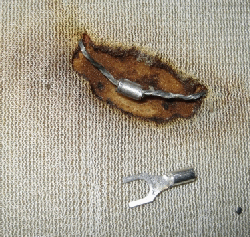 Although quite flexible, once damaged these can easily short. The pads are generally not repairable, they're expensive to replace and I know of no direct fit aftermarket replacements. If a thermostat fails, it will normally be to a non-fatal open
condition. The button thermostats typically fail when the attached wire
connection breaks (re-solder it). A relay thermostat failure is
typically evidenced by a shorter and shorter heating cycle. That will
either be a circuit board problem (re-solder it) or a component failure
(bad/failing resistor/capacitor/diode/thermistor/transistor.
Although quite flexible, once damaged these can easily short. The pads are generally not repairable, they're expensive to replace and I know of no direct fit aftermarket replacements. If a thermostat fails, it will normally be to a non-fatal open
condition. The button thermostats typically fail when the attached wire
connection breaks (re-solder it). A relay thermostat failure is
typically evidenced by a shorter and shorter heating cycle. That will
either be a circuit board problem (re-solder it) or a component failure
(bad/failing resistor/capacitor/diode/thermistor/transistor.
Grid Repair. [John Sargent] I made a repair to the driver's side lower seat heater grid in my 940. The seat heater wires are embedded in a thin layer of foam with fabric on both sides. The seat heater wire is flexible fine stranded wire. The wire breaks where it is flexed the most, generally in the seat bottom. One of the fine strands breaks from flexing, and since the cross section of the wire is reduced, this creates a local hot spot. Where one strand will break, another will break, and the spot gets hotter. Then another strand breaks, and it gets hotter yet until it fails. The broken (burnt) spot in the wiring is quite obvious, you can't miss it. I pulled enough wire out from both sides of the break to pull the ends through the crimp sleeve I made from a stake on fitting. I cut the fork off of a stake on fitting like is shown in the picture, and pulled both ends of the wire through the sleeve I'd made, and crimped it very hard. It is sure a lot easier than soldering wire that as been hot, and pressure connections are much better for carrying amps than solder connections are. I then made a repair to the seat cover over the wire.
Dirty Contacts.
Examined the switches for the electric seat heaters. Both sides had stopped working within the past year, and I had assumed the seat wires had failed. Surprise! Neither switch functioned; the contacts were dirty. It's a bugger to get the switch apart, but it's a simple hi-amp contact that's easy to clean. This is probably a common failure mode. Lamps Burned Out.
[DaveM] The bulb in the switch is part of the circuit when the switch is activated. It completes the circuit and whilst lit also allows power to the heater pads. Therefore, no light? No heated seat. A trip to the Scrappies soon put it right: change the switch.
Seat Heater Switch Removal.
[Inquiry:] Any advice on how to remove the seat-warmer switches? The little orange heater-on indicator light is burned out, and I need to get at the switch for the purpose of replacing the indicator bulb.
{Response: JohnB] On my 90 they're just clipped into the center console. I remove the screws under the parking brake handle and up comes the center panel and a bunch of wire harnesses. Carefully pop the harness connector off the switch and pop the switch out for replacement or repair.
Power Seat Diagnostic Trouble Codes.
[Editor] The power seat system incorporates an On-Board Diagnostic subsystem used for fault tracing and repair. Diagnostic Trouble Mode (DTM) 1 is used to read stored fault codes. DTM 4 is used to calibrate the seat if control modules, motors, potentiometers, drive cables or other components are removed. The OBD systems vary by model and model year: in 740 and many 940 cars, they require a cable connection between the seat connector and the OBD Diagnostic Link Connector (DLC) box in the engine compartment above the left wheel well. 960 and 1994-95 940 cars can read the codes directly by inserting the OBD selector pigtail into DLC box "B" position 6. Press the buttonin box "A" once to select DTM 1 and read out the codes. Erase codes by pressing the button for at least five seconds, wait until the LEDs light up, then press again for at least five seconds. After releasing the button, press it again to obtain code 1-1-1, indicating codes have been erased. If you have a problem requiring use of the OBD system, buy the Volvo OEM Service Manual TP 8501201 Power Seat for complete diagnostic and repair information, especially if you must re-calibrate the seats. If you can't get a flashing LED, see No Code.
Caution.Disconnect the negative battery terminal in order not to set off the air bag. There is an airbag sensor under the seat.
Won't Travel in One Direction.
[Inquiry:] In my 960, the passenger side 8-way powered seat works in all directions except down in front.
[Response: Mike Froebel] You have a dirty switch. I have had good luck carefully prying out the rocker part - the part you move with your fingers. Pry that plastic out from the front or rear. Once again, be careful, there is 6 small parts in every switch. Clean all electrical contacts by scraping with a dull knife, and get all the sandwich crumbs out. Grease the 2 balls (also helps to hold everything together) and snap it back in place. You may also have a broken solder joint where the bottom of the switch is soldered to the circiut board. You have to take the assembly out to do this. There are 2 bolts holding it in from the bottom. Either way you should be able to fix it for no money.
Seat Back Jammed.
[Tip from Don Willson:] On a trip last week the seat back quit working on one side. So I clipped the hog rings at the bottom of the seat and pulled the upholstry up like pulling off a sweater until I could get to the flexible cables. After quite a bit of investigating I figured that the motor and gear boxes were OK. I finally decided that the flexible shaft inside the housing to the inner gear box was too short and had slipped out of the gear box toward the motor end. Since I could not stretch the cable I shortened the housing about 3/8 inch and reassembled it and it works fine.To synchronize both gear boxes leave one unconnected and move the other side back and forth until it is about in the middle of the travel with the other side not moving, then reconnect the loose side.
Cable Failure on One Side.
[Inquiry] My drivers power seat will not move forward or backward on one of the rails. This causes the seat to twist rather than move forward/backward.
[Response: DanR/Bob] The same motor drives both sides via cables from each end; these in turn move each side of the seat. What happened on my seat was that the inner cable's end had rounded out on one side or has pulled back inside the sheath. The cables are round except for the last few inches where they are square. The square ends fit into the motor shaft and the gear on the track gear box. It seemed that the inner cable should have been longer than it was as just the last 1/8 inch was making it into the gear housing on the track. Many folks have repaired this by making the outer sheathing shorter to get more of the inner cable to seat into the gear housing. Inserting a Nail to Lengthen the Inner Cable. I didn't see any way of getting the metal sheath off the cable without destroying the ends. So I left it alone, all I did was insert 1/4 inch piece of round steel in the inside of the motor shaft to push the cable through the sheath further into the gear housing [Tip] Cut off a finishing nail to a length of about 1/4", squareish on both ends. Drop it into the center hole where the cable fits into the motor; put the cable back in and reinstall everything. Shortening the Cable Sheath. The cable covering can stretch and won't allow the actual inner cable to engage in the gear drive. To repair, you'll have to remove about 1/4" inch of the shrouding from the end of the cable. [Kerry O'Connor] The end of the sheathing has a metal cap or ferrule. Cut the sheath off at the base of the ferrule. Take it off the cable, and dig out the plastic sheathing. Put it back on the cable and slide it back to the sheathing. Now the fun part: Grab the ferrule lightly with some locking pliers. Heat the ferrule with a lighter or torch, then slide it on to the plastic sheathing. When it bottoms out, give it a 1/4 turn. This will lock it on to the plastic sheathing (via the barbs). All this has the effect of lengthening the cable by shortening the outer sheath.
Diagnostics.
[Fred Morefield] You first need to figure out which cable is inoperative. To do this, run the seat forwards and backwards and see which side is moving and which is stationary (faulty). Then run the seat up as high as it will go so you can see under it and follow the cables from the motors to their respective servos. When you find the cable that runs to the dead servo grab it in hand and run the seat forwards or backwards and make sure that you feel the cable spinning in the sheath. IF it does then at this point you can usually get it to operate by pushing that cable one way or the other and getting it to engage. Doing this will allow you to move the seat all the way one way or the other which will facilitate accessing the bolts to remove the seat.
960 Cable Removal, Repair, and Reinstallation [Jay Simkin]
- Remove the seat from the car.
- Position the seat bottom-up on supports (with towel or blanket to protect the upholstery), such that the leading edge of the seat is closest to you. The leading edge is that which is against the back of the driver’s or passenger’s knees, and thus the edge closest to the windshield, when the seat is installed.
- Find the seat motors, a three-unit cluster, mounted towards the seat’s leading edge.
- To the right of the motor cluster, you will see a black steel bracket, with a “D” shaped hole in it. The round side of the “D” faces the seat’s leading edge .
- On the underside of that bracket, on the left side of it (i.e., the side closest to the motor cluster) you will find six, 8-mm, hex head, self-tapping screws. These six screws secure the bracket to the motor housings.
- Use 1/4" socket tools. You will need an 8mm socket, a 4" or 6" spring flex shaft, and a ratchet. Starting from the screw closest to the seat’s leading edge, remove these screws. You can insert the spring flex shaft through the “D” shaped hole to access some of the screws. Note: there is no need to touch the screws at the other end of the black steel bracket, that closest to the seat track.
- When you remove the screws, you will notice a slight gap (3/16", 3-4 mm) opens up between the bracket edge, and the studs on the motor housings, from which you removed the screws mentioned in (E). Do not be concerned. You will close this gap, when you re-install the screws.
- You can now remove the drive cable end from any of the three motors, by pulling the black plastic cable housing straight towards the “D” shaped hole in the steel bracket. The end of the drive cable is not secured to the motor housing by a set-screw. You will see that at the motor end of the drive cable, the bright metal cable housing is slightly flared. This flare in the cable housing allows the black steel bracket to snug the end of the drive cable housing, into the motor housing opening, when the bracket’s 6 mounting screws are tightened.
- Once the motor-end of the drive cable has been removed, you can remove the other end, from the track drive gear mechanism, beside the seat track. You can then replace the cable.
- In some cases, you can restore function, by pulling the drive cable out of the black plastic housing and reversing the cable, i.e., inserting the end that was closest to the motor, so that it goes into the track drive gear mechanism. This may be worth trying, if the end of the drive cable, that was closest to the motor, is slightly rounded or worn, and if the end, that was closest to the seat drive mechanism, is not rounded or worn. While a slight rounding may stop the motor from turning the drive cable, slight rounding or wear does not seem similarly to affect the drive cable’s capacity to turn the track drive gear. [Kevin Kazanjian] I have fixed many seat cables on 800-900 volvos and have found that using a small pair of vise grips, you can lightly clip onto metal collar, with cable removed, and heat with a lighter. When the metal heats up, it will slide off the sheath. Clip off a small amount of sheath, reheat metal retainer and slide back onto sheath. You will see the plastic slightly ooze out around crimp holes in retainer. It will not come apart
- Once you have installed a new drive cable assembly, or reversed the drive cable in its housing, you should test the new assembly.
- Testing and Reinstallation:
- Using your hand, push the end of the track drive cable, into the motor housing, and hold it firmly in place. Use the seat switch to activate the motor. If the tracks (normally bolted to the floor) move smoothly and completely, forwards and backwards, you’ve restored the seat to good working order. You may want to lubricate the tracks with a spray grease (e.g., white lithium). If the seat tracks do not move smoothly and completely, forwards and backwards, check the tracks to ensure they’re free of obstructions (e.g., coins, dirt, debris, etc.) and not bent or otherwise damaged. Clear any obstructions, and re-test. If the tracks are bent, or teeth broken, the tracks will need to be replaced.
- Reinsert screws into the holes at either end of the black steel bracket, and tighten them “snug”. REMEMBER: these screws are going into plastic, so brute force will strip the hole!!! Tighten the two end screws alternately (rather than doing one completely, and then the other). This alternate tightening will gently and evenly draw the steel bracket towards the motor cluster, pushing the ends of the drive cable housings into the motor housing openings. The four middle screws need not be re-inserted at this point.
- Re-test any repaired drive mechanism, to ensure it still works through its full range of movement. If it still does so, insert and tighten the remaining four hex head screws. Go GENTLY: these screws are going into plastic studs on the motors, so it is easy to strip a hole.
- Re-install the seat in the car.
960/90 Seat Motor Failure.
[Inquiry] My 960 driver seat front back motor works with the switch but only the left track moves. The right (inner) track is stopped. It seems to be clear but it is stopped. Is there a fix that someone has performed? [Response: Peter Rhyins] This is a common problem with 960 seats. Volvo considers this an adjustment, and has a service bulletin to do the procedure which requires re-connecting the shaft which has stripped off (see above).
Seat Alignment.
Unfortunately, once you've re-connected the motor shaft the seat needs to be realigned so that both rails move forward and backward evenly, and to prevent further damage to the motor which can fail if this re-alignment isn't done.
Manual Non-Computerized Seat Alignment:
- [Jay Simkin] First remove the drive cable from its opening in the seat track drive motor (the middle one in the cluster).
- Supply power to the seat, from a 12-volt battery (or portable 12-volt source) through leads with insulated (red and black flexible plastic), spring-loaded alligator clamps. The wire from the positive pole of the battery/source should go to the spade terminal, for the red wire on the grey connector and the wire from the negative pole of the battery/source should go to spade terminal for the black wire on the grey connector.
- On a passenger-side powered seat - which does not have “memory” - use a carpenter’s steel framing square (16"x24"). Place the short leg of the square along the outer edge of one of the tracks, with the long leg extending parallel with the leading edge of the seat, until it (the long leg of the carpenter’s square) extends past the track on the other side of the seat.
- Use the seat switch to advance the powered track, until it just touches the edge of the carpenter’s square. Both seat tracks are now aligned.
Computer-Controlled Seat Alignment:
On a powered driver’s seat - with memory and its own seat computer - you may need to take the seat to a Volvo dealer, to get the tracks re-aligned, if the method set forth above, does not restore synchronous track movement. The alignment can only be done with a Volvo diagnostic computer that can detect the stepper motor current while driving both rails to their end stops. If they aren't both at the exact same place, you'll have problems.
Re-Setting Seat Position When the Switch Has Failed [Jay Simkin]
This is a work-around to be used to move the seat when the seat switch unit has failed. This work-around allows power to be supplied to the seat motors so that the seat can be moved.
The seat should be removed from the car. WARNING: Before removing the driver's seat from the car, the SRS System must be de-activated. To do this, remove the battery negative cable clamp from the terminal, and put the terminal in a plastic bag. This will prevent accidental airbag deployment. The airbag sensor is mounted on the floor pan, under the driver's seat. An accidental airbag deployment can be lethal at close quarters.
Put the seat on a flat surface. Under the seat, you will see the three seat motors, mounted next to each other. Atop the black steel motor mounting bracket, there's a black plastic connector - secured to the motor mounting bracket with a yellow plastic circular clip. This connector attaches the wires from the seat switch cluster to the motors. This black plastic connector houses six wires, white-black, yellow-green, and blue-violet. These wire pairs drive the seat motor, that control front-to-back, seat bottom tilt, and seat height. To change the direction of movement, reverse the red/black wires from the battery or portable 12-volt source. Thus, if red to white / black to black moves the mechanism in the direction opposite that you wish it to move, connect red to black and black to white, to reverse the direction.
Seat-back angle is governed by a separately-mounted, in-seat motor. It is powered by a separate yellow-green wire pair. Here, too, motor direction (and so seat angle) is changed by reversing the wires.
Here are the wire pairs:
- Red = + (positive)
- Black = - (negative)
- Motion Front-to-back - To move seat forwards (towards dash): Red to Purple// Black to Blue
- Seat Tilt - To tilt seat downwards (towards floor): Red toWhite // Black to Black
- Seat Height - To raise seat (towards roof): Red to Green //Black to Yellow
- Seat Back Angle - To bring seat upright (straight up): Red to Yellow //Black to Green
To reverse these movements, reverse the wire sequences set forth above.
Reconnect the black connector, and secure it to the motor mounting bracket, with the yellow plastic clip. Re-connect the two-wire seat back angle control motor, by inserting the male into the female connector
Power Seat Switch Cluster and Computer Removal and Repair.
Cleaning and Accessing Switches.
[Inquiry] My seat is stuck, I assuming its in the switch cluster, any tricks to removing and replacing it?
[Response: John ] Assuming it's a switch problem (could be checked with a test light), it's possible that dirt, soda, moisture, etc has corroded or gummed up the 'stop' switch contacts. Try spraying electrical contact cleaner (via radio shack or wherever) directly onto the switch assembly from the top while moving the stop switch on/off. I've often had good luck doing that but worst case scenario is that your switch assembly (called a power seat controller) is NG. They're not cheap, over $150.
[Response] There are two bolts that hold it in from underneath, which can be difficult to get to if you can't raise the seat. I was able to fix an intermittent problem by re-soldering the connections on the circuit board.
Wiring Harness.
[Further Inquiry:] I got a new switch. Its easy to get the switch out, the tricky part is the harness, and the front seat cushion, Anyone know how to remove the cushion? the harness disappears under the carpet, any ideas where and how much of the carpet to lift up? Why Volvo decided to have a 24 inch harness on this switch has got me, you would think a connector could have been built into the switch housing, and tie right into the main harness.
[Response: Bob] You can pull up the front part of the cushion. The front part of the seat cover is attached by a rail going side to side. Usually has a clip in the center. Remove the center clip, grab the center part of the seat cover where it wraps around the seat frame, bend the rail out in the center so it will come out of its holes on each end. Then you will find an S hook attaching the cushion to the frame about 6 inches from the front. 1 hook on each side. The wiring plugs in near the outer seat mounting bolt. There is a plastic cover attached with 1 screw at the front of the left adjustment rail. Remove screw and cover, pull up the carpet slightly and you find the 3 connectors for the switch. One connector may not match, as they changed them. If so, you can either order the plug and terminals at the dealer or splice color for color.
Electrical Problems.
[Inquiry] None of the power controls are currently working on the seat. Since there are separate switches for the forward/backward and tilt functions, I'm pretty sure it's not the switch. I also checked the fuse, and that's not it either. One person at the local dealership suggested that there is a relay that might be at fault, the fellow at the parts department claimed there was no such relay. What do I do now?
[Response: Steve] There is a separate 25A fuse for each front seat. The relay was mounted on the switch board on the non-memory type seat used to '92, and often had cracked solder joints on the switch board. Memory seats have a separate control unit.
90-Series Seat Computer.
[Eric S.] 90-Series cars have a little (for lack of a better term) computer box under the driver's seat, hung under the seat cushion behind the power units for the motors. It's a little black plastic box with 5 different relays and a circuit board. This is where the seat memory positions are stored, because when I replace mine, the seat had different preset positions. If you remove the black box, you can pry it open. I did and found that the circuit board had two burned out spots on it. It's worth checking out before you start dimantling the motors.
[Inquiry:] The seat adjustment switches on my 760 do not work unless I push on the bottom of the circuit board. When I do this, I hear a click (like a relay connecting) and then they all work. I will re-solder the connections on the bottom of the board, but I can't figure out how to get the board out of the plastic case, so I can get at the other side. Does anyone know how to get the board out of the plastic cover?
[Response: Craig Henrikson] Remove the cover over the rear seatback gear unit and then take out the phillips head screw at the rear of the plastic pod that holds the switch assembly. There is also a similar screw at the front of the pod that is not easy to get at but a good offset screwdriver should do the job. Both of these screws go into the seat frame. On the bottom of the pod there are 2 bolts that hold the switch assembly in place. Remove these and you and pull the switch assembly up -- this should give you limited access to the PC board. You can them resolder to your heart's content. If this doesn't give you enough room then remove the seat (4 bolts - push to rear and lift) and you can then cut some of the cable ties under the seat to loosen things up. NB -- The switch assembly is a single unit with multiple solder points to the PC board -- if you need to repair a switch GENTLY pry up on the switch actuator and you will have access to the interior of the switch. All the PC board wiring is on the bottom of the board. My major problem has been the on/off STOP switch -- it is easily bypassed by soldering a short wire between the 2 board connections toward the rear of the stop switch section of the board. Note that there are 2 relays on the board and you can't get at them if they are defective but you can probably bypass them if you are daring!
Seat Mechanicals:
Front Seats?
[Inquiry:] Are the driver and passenger seats interchangeable in 74x, 76x, and 940 cars?
[Response:] The short answer is sort of yes. The front seats use the same symmetric components mounted differently for left and right seats. The basic frame is ambidextrous. The lumbar support can be swapped around from left to right side (of course, the upholstery will have the hole for the lumbar adjust knob on the wrong side), as can the seat belt anchors, reels etc. The part that's not as trivial is the seat track and associated height adjustment. Earlier models, I think 86 and older, have left-right asymmetric tracks, though it looks like with a little bit of metal smithing that can be taken care of. [John Sargent] The front of the seats fasten differently for 1986 and earlier. It is an easy work around, or just use the rear bolts for temporary fastening.
Generally, only the left driver's seat came with height adjustment, and typically only manual, except for some 760 and 780 cars. Therefore, I'm not sure that the height adjustment mechanism transfers to the passenger side easily (i.e. the mechanism is symmetric), though I could be wrong. Power seat mechanisms can, as far as I have been able to tell, be moved from left to right as long as the bottom of the tracks is symmetric, which I believe happened in 87. As far as the difference between older, asymmetric tracks and newer symmetric-looking tracks, the front outer track mount differs slightly between 86 and 87, but if the car itself is 87 or newer (accepting newer tracks), the older style track mount can be modified very easily to fit the newer body. If an 88 seat is to go into an older body, the 88 track needs an additional piece of hardware, and I doubt you can buy that piece separately, so it would help to have an old donor seat. Power seat electrical connectors may differ among models and years, which can be easily rewired. See the discussion below for more details on installing power seats in a manual seat car.
Foam Cushions?
Yes: front bottom cushions are swappable left to right.
700/940 versus 960/90?
[Inquiry] I have a line on some great front seats from a 1993 960. Will they bolt in to my 1990 760? Both cars have power seats.
[Response: Bob] Yes.
240 versus 740?
[Inquiry] Can I use 240 seats in a 740 or vice versa?
[Response] No: they have completely different configurations.
Rear Seats?
[Inquiry] Are the 700 and 900 rear seats interchangeable?
[Warren Bain] The sedan rear seat back cushion will be too high. The rear of the 944 is higher than the 744. I know this from personal experience: I replaced my 744T interior with one from a 944. Everything else except the headliner and the padding surrounding the two small rear side windows will fit.
Squeek in Seat Latch.
[Inquiry:] I have a 92 960 Wagon with 91K miles. It has an annoying squeak that appears as though it's coming from the roof pillar (right behind the backseat no the driver's side). It squeaks when going over bumps.
[Response: Lance Schumacher] I had a similar problem on mine. It turned out to be the latches for the folding middle seat. I put some Vaseline on all the contact points and the squeak disappeared.
Release Lever Does Not Work: Quick Fix. [David Lee] I did not fix the broken release lever problem outlined below, I just found a work-around. If the broken lever is the one closest to the middle of the car, this 'fix' worked for me. Llower the center arm rest in the back seat and push your fingers into the crevice on the left side (closest to the left seat edge). You should feel the verticle wire that connects to what used to be the functioning release handle. Pull that rod until it is bent enough to be easier to reach your fingers. When you want to lower the seat, just put your fingers into the crevice and pull upward on the wire while pulling the release lever to the driver's side of the seat.
Release Lever Repair.
[Inquiry] How do I fix the release lever on the fold down rear seat? Mine has snapped off/out completely.
[Response] Note to all 745 owners----the backrest release mechanism is fragile, with several small brittle plastic parts involved. Be gentle when operating it. You don't want to have to do this job, which is difficult. First I had to figure out how to get the latch to release in order to remove the back rest. It turns out you have to pull one of the control rods and push the other at the same time. Once it can be lowered, you have to depress a spring loaded pivot pin at the on the outboard side, and perhaps unbolt the hinge assembly at the center. With the backrest out of the car, you have to skin it, and dismantle it completely to install the replacement parts. If you can find at the junkyard a matching backrest with a working mechanism you can swap, that makes the job go a lot quicker. [Lawrence Saiyo] I just fixed the same exact problem. My seat release lever broke on the previous owner and they slammed the seat back, locking it in place, causing it to squeal while driving and be jammed in the up position.
- Pry off the piece of trim surrounding seat release lever.
- Locate and remove screws retaining seat release lever (top and bottom, sometimes covered by the seat-back fabric.
- Pull lever straight out, and watch for falling parts.
- Your problem likely is that one of the three pegs on the rear of the lever (two molded on place, one which is moved my the handle) snapped off.
- If the peg is stuck (clipped) into the internal white lever unit, you're in luck, if not, go fishing via removing the seat. it will likely be the fixed peg clipped into the white unit, as it undergoes most stress.
- If still clipped into the internal lever unit, Remove the white internal lever unit. Note orientation and placement of seat release lever rods to avoid installing backwards/in the wrong place, draw a picture, youll thank yourself. remove by pulling the lower release rod cotter pin (right side) and pushing out the plastic rotator pin (should be about 2/3in long, 1/4in dia, and threaded onto the lower seat release rod). CAREFUL not to lose the tiny spring washer and cotter pin. Leave the plastic rotator pin threaded into the lower seat release rod. Then remove the left/upper seat release rod by fanagling it off the rod, the upper seat release rod is just positioned through a hole on a tab located a little outboard on the left, no special pins or spring washers.
- At this point, if your seat is jammed, flip up the bottom portion. simultaneously pull the upper release rod and push the lower release rod to the left (till you
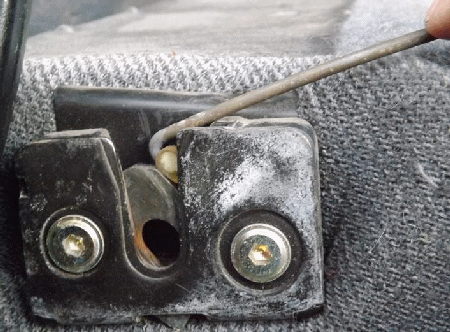 hear a click) and shimmy/push the seat out of its jammed position and get it to fold down, this will likely reset the seat retainer/locking bits, unjamming the seat. if the upper seat release is stuck in the closed position, but not engaged in the retaining hook/rod, pull the upper release rod to the left and rotate the seat release towards the back of the car (counter clockwise) and release the rod. this will reset that lever mechanism so it will catch and lock in the retaining hook/rod.
 - Back to the white inner release rod, remove the broken peg via screw driver, or as i did, file down the broken bit and push it through.
- Position this peg on the backside of the outer, main release lever, (youll see where it has snapped off) with the small recessed bit facing towards the edge of the unit. (use other peg as reference) I used JB weld and positioned it and waited 24hrs.
- Now that you have repaired the main lever unit, reassemble the inner release lever as you found it, upper release rod first by fangaling it throught the hole. Install spring washer, position inner lever, then cotter pin it to attach lower release rod. you can unthread the rotator pin if you want to adjust it before you attach it, I unthreaded mine so the end of the rod was flush with the hole, resulting in farther rod throw, and more reliable disengagement.
- After inner bit is installed (should just be hangin' out in there) give 'er a good spray with silicone lube. this plastic was intended to be self lubricating poly-something, but has likely roughened up with age and use. spray the internals on the upper release mechanism while you're at it too, since it is reachable via spray tube.
- Install the grey outer/main lever after spraying sliding pin with silicone lube. clip your repaired broken pin back into place (like a charm, if you positioned it right), and position other pins. Remember you want the tabs the screws install into on the lever on the INSIDE of the seat back.
- Screw back into place, reinstall trim, and let your magic work.
I used some poly lube on the surface in which the lever slides across on the outside, and that made it run much smoother. May be a good idea to lube both release/locking mechanisms to keep it running smooth to prevent future breakage. this repair is fairly easy if you have some patience. My repaired piece is strong enough to be used daily for probably the rest of the vehicles life.
Safety Caution! [JohnB] Disconnect your battery negative cable before removing the front seats or working around the crash sensor under the driver's seat. The air bag wiring harness is fairly safe, but it's possible to nick one and/or inject a static charge and fire off the airbag. It's also possible to drop something on the crash sensor and do the same. Nearly every safety note on airbag equipped cars says to disconnect the battery and wait 20 minutes before messing around where the airbag can be tripped. It goes without saying that you should NOT work around or under the airbag or crash sensor with the key in the ignition and the radio on. If your sensor does go off, the combined cost (new) of a replacement air bag and sensor is more than $2,000.
Front Seats: [Tips: Jay] To remove the front seats in the 700/900 series:
- Unscrew the side seat pocket. Unbolt the seatbelt retractor from the seat (reinstall at 35 ft-lbs). See the caveats in the SRS section about removal of the retraction mechanism.
- Unscrew the plastic cover to the outboard front corner bolt.
- Disconnect the wire harness connectors located near the outboard front corner of the seat track.
- Pop off plastic covers to 2 rear bolts holding the seat down. There are two ways to do this (at least in my car): either push down and slide away from the seat, or take a pocket knife and wedge the edges of the plastic thing.
- Unbolt 4 bolts (reinstall at 35 ft-lbs)
- Get in the back seat, bend over, and with one hand near the base of the seat and the other near the shoulder area (for balance), slide the seat all the way back; then push forward a bit (.25 inches). You may need to lever the rear of the seat track up over the back detent. Then pull/tilt the rear of the seat up. It's much easier on your back if you have a helper to maneuver the seat out with out tearing up your door panels etc. What you're looking for is trying to get a lug out of the keyhole shaped cutout on the floor of the car. If you didn't get it the first time, slide the chair forward or backward slightly and pull up again.
- Once it's out of the lug, put the seat in the most upright position (seatback 90 degrees to the seat) and take the seat out of the front door. I did this standing right outside the front door (pretend it's the driver side). My left hand grabs the bottom front underside of the seat. My right hand holds either the headrest or shoulder area. Then lift and take out. Try not to mess up your back.
Re-install the front seat in the car by aligning the studs on the seat track bottoms with the holes in the seat pan. When the seat is flat on the floor, move the seat, until the holes at the end of the seat tracks match the holes in the floor pan. Insert the seat bolts and set the threads into the holes, by turning the bolts by hand, counter-clockwise, for one full turn. You should hear/feel a slight “click”, when the thread on the bolt engages the thread in the hole . Hand tighten as much as possible, and then torque to 33 pound/feet (45 nM). Hand tighten and then torque the seat belt anchor bolt to 33 pound/feet (45nM).
- Remove Rear Seat Bottom Cushion--About 6 inches in from either side, on the leading edge are latches that hold by way of foam compression. With the palm of your hand, PUSH IN...Then DOWN, Then lift up and away, both sides.
- Remove Rear Center Headrest--Extend upwards...lift and unsnap lower section of plastic cover. Then remove 2 phillips trim screws on upper part of plastic cover..really have to pull up on the headrest as you do this..set plastic cover aside...Remove 3 bolts w/10mm heads...withdraw center headrest.
- Remove Seat Backs--Find metal tabs at right and left lower corners, bend slightly upwards and pull lower part of seat backs outward. Lower the center armrest to about 45 degrees. Push up on seat back until upper corner tabs/slots come free, pull entire seat back ass'y forward over and away from center armest. CAUTION.. feed 3 seatbelt straps carefully over seat back as you withdraw it from car.
- Remove 2 Remaining Headrests--Take out 2 bolts w/ 10mm heads, each side, remove reinforcement plates, withdraw headrests and set aside. Remove 3, T-25 screws that secure Rear Deck Panel.
Seat Tracks. See Safety Caution Above.
[Inquiry] When I disassembled the passenger seat to fix / lube the seat rails 2 ball bearings fell out when I slid the rails off the bottom of the seat assembly. I didn't see where the came from and re-assembled the rails without them, but now the seat wobbles a little from side to side and front to back. Anybody know where they came from ? How to re-assemble this (non Electric) seat?
[Response: John Hibbert] I have the same problem with my 93 945. The tracks are very successful at collecting Aussie sand, resulting in jammed runners. In attempting to clean the runners I ended up with ball bearings and rods and no idea where they came from. After much thought I reluctantly had to admit failure and posted to Brickboard. Gregg Stade very kindly posted a detailed reply, however I've been too busy to follow his advice. It goes as follows- 'I think there should be 2 rods and 4 ball bearings per side. Note how the tracks are positioned.......... Now to the small pieces. I think what I did was lay the rods and bearings in the grooves on top of the track rail still attached to the seat and then gently slid the removed track on, over them. The order of the pieces is as follows: bearing, rod, bearing near the front and then another series of bearing, rod, bearing near the rear of the same track. While sliding the removable track on you'll probably need to temporarily hold the pieces from sliding out of position until the track is completely on. It may take a couple of goes to get it right. You'll know you have it right when the removable track will slide very easy on the fixed track.'
Seat Track Extenders. [Editor] Both Volvo and http://www.seatextenders.com/ offer seat track extenders to increase distance from the steering wheel.
Removing the Seatback:
See Safety Caution above. Remove the seat for ease of access. To separate the seat back and the bottom, remove the 4 bolts that point their heads inside, under the rear of the seat bottom. To open both the seat back and the bottom, you will have to bend/cut the small wire clips that hold together the rods at the end of the upholstery. You can try to reuse these clips at reassembly, but I usually just use those plastic ties used found at automotive stores in a multitude of colors. For the bottom, the upholstery is also held on the side of the seat by small hooks protruding from the frame. These should be easy to deal with. There is also a bigger metal clip on both sides that has to be forced off. After removing all these, you should be able to peel the upholstery back after unhooking the metal rod at the back end. There is also a metal rod held down with some clips at the center of the seat. For the seat back, you have to remove the small plastic panels on the sides of the seat (right side this means removing the knob for rake adjustment first by turning the locking ring inside it). You should also remove the lumbar support knob: just turn it CCW till it comes out, then the base should just come off. As for the above mentioned plastic panels, the bottoms snaps out, and then you push upward to unhook it (it's pretty tricky and I have broke some, I hope I remember correctly the setup!). Once you removed these plastic panels, you'll discover similar small hooks as on the seat bottom. After unhooking those, you should be able to pull up on the seat cover and get the job done. This is a great opportunity to repair a broken lumbar support mechanism!
Removing Seatback Cover. [Tip from Herb Goltz] Removing the back is easier than the seat bottom. Recline the seatback as far as it will go-- the first set of hogrings are at the bottom-- I think there are 3. Cut them with a pair of heavy wire cutters. It will also help to remove the plastic covers over either gearbox on the sides (probably a big phillips). Roll the cover up like a sweater. You will encounter 2 hogrings internally at some of the pleats in the seat. Cut them too and keep rolling. In order to get the headrest off you will need to feel for the vertically oriented rods from the back of the seat. The headrest is held in place by plastic retainer springs. Press in very firmly at the base of the rods while a helper pulls upward on the headrest. It is a little tricky to figure out exactly where you need to press, but you will get it to come out eventually. Then you can just pull the cover off. While it is off you can also fix broken seat heater elements and repair the lumbar support if it needs fixing.
To replace the cover, use nylon cable ties instead of the hogrings. The seat covers have metal rods sewn in that you need to capture with the nylon ties the same way the hogrings used to. If you are expecting heavy use, you could use 2 at each point. I trim off the remaining ends with wire cutters.
Lumbar Support Repair. See Safety Caution above. [Inquiry] am hoping that someone can provide me with careful step-by-step instructions and tips on how to replace the lumbar support mechanism in both my front leather seats.
[ Bob/John Hibbert/Rodrigo Silva Solution] I had the same problem with my 93 945. The most common failure is a broken adjustment bracket screw: the large white screw in the photo which separates from its square end support piece on the other side of the adjuster. This is a design fault. IPD sells a rebuild kit for US$65 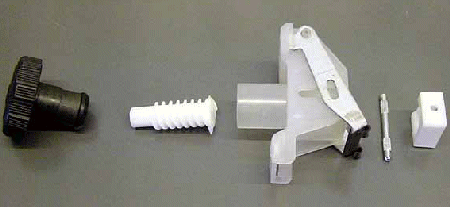 that contains all needed parts. The following are the steps I followed:
- Remove bottom section of the rear seat behind the one you wish to repair. In the wagon it simply clips out. This gives better access and enables front seat to recline further.
- Recline the front seat as far back as it will go. This will reveal 3 wire hog ties used to keep the extension of the backrest's front and rear covers together, thus preventing the entire backrest seat cover from slipping. Cut these with a pair of pliers and remove the remnants. Replace them with plastic ties on reassembly.
- Return seat to the upright position.
- Remove the lumbar support knob by turning it anti-clockwise. You will feel it turn more freely when it disengages from the internal thread. By pulling it firmly it will now come away. Also remove the trim bezel. It simply pulls away. The larger knob, the rake adjustment knob does not need to come out.
- In the bottom edge of the front and rear faces of the seat cover where the rings were, you will see two metal rods going the width of the seat inside a pocket. Remove these rods.
- Tilt the seat to enable the front section of the seat cover to be pulled through to the front.
- Now commence pulling the seat cover up as though you were removing an article of clothing over your head by turning it inside out from the bottom. About 6 inches up you will feel some resistance. On both sides in the back, there are 2 elastic straps with hooks attached to the frame. Tilt the seat as far forward as you can and by getting down in the rear passenger footwell you should be able to unhook these with needle nose pliers and it will enable the seat cover to be pulled up high enough to reveal the lumbar assembly. You don't have to remove the cover completely, just 8 or 10 inches until you see the lumbar bracket.
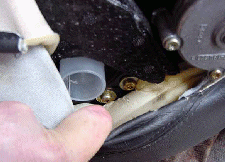
- Disconnect the strap that stretches across the back of the padding. When tensioned it shapes the seat. This is done by putting pressure on the two clips.
- Move to the outside of the seat again. Get your T-25 torx screwdriver from the Volvo tool set. Three screws can be found rearward from the knob you have removed. They hold the lumbar assembly in place. To access them you will need to gently push padding out of the way and maybe slide the seat to give room to work.
- Remove the mechanism from its internal location. The problem will now be obvious and most likely be a break in the plastic bolt-like fixture. It has a hollow rectangular head. Mine was broken through this head. This head has a pin passing through it.
- You now have two options- install the rebuild kit for $65US -or repair by placing a 10mm bolt through the centre of the adjuster to tie it together and strengthen it.
[Scott Morford's Easier Solution] In the FAQ, the lumbar repair covers more than necessary. I have repaired the broken screw assembly many times in my 4 Volvos (740 and 940). The threaded portion pulls out of the nylon assembly due to stress from being tight(full support).
- Remove the broken threaded piece of the assembly by turning the lumbar support knob on the seat counterclockwise.
- Move seat full forward.
- Put back as far forward as possible.
- At the bottom of the seat back cover, there are 4 wire retainers. Clip them to release the top and bottom covers. Leave the wire in place.
- Lift the seat back cover upward until you can feel the lumbar support assy.
- Using a needle nose plier, you can pull the retaining pin in the assembly down, accessing from the back side of the square nylon piece in the assembly. You can also tap it out using a punch. I've found the pliers easier.
- Once the pin is removed, the broken square piece is removeable.
- Remove the nylon assy and pin from the new support bracket.
- Insert the nylon screw assy into the mechanism
- Insert the retaining pin and tap into place to hole the new nylon assy in place.
- Test by reattaching the knob on the seat and adjust.
- Pull the seat back cover back to its original position.
- I use bent-nose small needle-nosed pliers to reach from the bottom seat cover, through the holes in the bottom and top covers. BE SURE TO GO AROUND THE RETAINING WIRES. THESE HOLD THE BACK AND CUSHION COVERS TOGETHER.
- I use small wire ties, put the small end into the 90 degree pliers, then pull through the hole. Attach but don't tighten until all 4 have been put in.
- Tighten the wire ties and move the seat to your normal driving position.
Repair:
- To repair you will need - a 75mm x 10mm cup head bolt, an electric drill, drill bits from 11mm downward, hacksaw or grinder and file, and a small nail or pin.
- Remove the pin that passes through the head of the plastic bolt by tapping with a rod of smaller diameter. This enables the broken bolt to be removed.
- Drill an 11mm hole through the centre of the hollow rectangular section of the plastic bolt. It needs only be wide enough to enable the 10mm bolt to snuggly slide through the centre.The head of the bolt should be at the rectangular end.
- Fit the broken section back together and carefully align the drill so it passes through the plastic casing, then the bolt and then through the plastic casing on the other side. This is to enable the pin you removed to locate in its original place and at the same time pass through the bolt.
- Once again check that the plastic bolt is together as it should be. Drill a hole the diameter of the small nail or pin you plan to use, through the non threaded end section of the plastic bolt. This hole must go through the plastic, steel bolt and plastic to enable the pin to locate snuggly. It keeps the plastic bolt together and enables it to be wound in and out without breaking.
- Cut bolt so that it finishes flush with the plastic end. File pin so that it also is flush. The cup head at the other end doesn't have to finish flush.
- Proceed with cover installation below.
Repair [Norm Cook's Solution]:
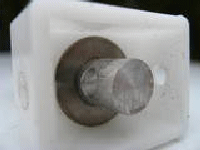
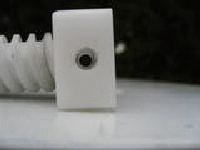
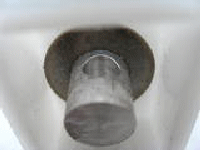
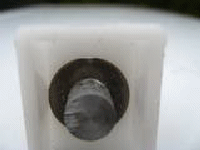
Here's my overly-complicated method of fixing the cheesy-engineered lumbar support on my 1989 740T wagon: I held the broken pcs together and used a suitable transfer punch to locate the center of end part. Then glued the broken pcs, using krazy glue or equivalent (cyanoacrylate). Starting with a 65mm long x 9.55mm dia (3/8") alum rod. 55mm of the rod is machined to ~8.8mm, as the inner clearance of plastic threaded part is 9mm. The end thread M8 x 1.25mm is secured with loctite. Once part is tightened down, I drill the 5mm pin hole in head of 3/8" rod. Photos below.
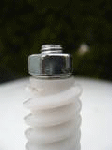
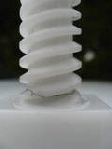
Rebuild with Kit:
- Remove the anchorage point on the left side (this is the side that has the knob, and the side that actually moves to tension the lumbar strap). There are three screws hidden under the hard styrofoam on the rear side of the backrest and the soft cushion on the front side of the backrest. Gently pull apart these two pieces to access the three screws. The IPD kit also provides new screws.
- Once the mechanical piece is installed, place the strap in the clips that are provided for it. The metal tabs on the strap should pop into place on the adjuster mechanism. The other side should be similar but the only annoying thing is the center console may get in the way.
Seat Cover Reinstallation:
- Pull the seat cover down and over the rear section and the front section so as to cover the seat again. be sure to massage the foam into its proper place so as not to have any funny looking bulges anywhere. Once the cover is all the way down, and you have the flaps of fabric in the front and rear of the seat, recline the seat backward little by little, and stuff the rear flap of fabric throught the area where the seat cushion and the back rest meet, so as to have it protrude through that area once the seat is completely reclined.
- If using zip ties to resecure the cover, put the end of the zip tie through the old metal ring hole on both pieces of fabric. Patience with a little tugging to pull the fabric through a little more is the basic idea. Once you have the zip tie through, you can cut the end with wire cutters. Reassemble. .
Front Seat Bottom Foam Replacement (Editor: this has been edited for 700/900 cars, which have different seat construction from 240 series.) [Tips from Paul Seminara]
- See Safety Caution above. Remove seat from car by unscrewing the four bolts securing each corner of the tracks. The front outboard bolt is covered by a plastic molding which is unscrewed. The rear screws are covered with a plastic surround; pry outwards gently on the sides and pull them out. Unplug the seat heater and power seat connections at the front corner. Unscrew the side of the plastic pocket. Remove the seat belt at the side seat frame.
Pull the entire seat assembly, including tracks, back as far as it will go. Lever up the rear tracks over the metal detent if they catch at the back. Then move the entire assembly forward five millimeters to locate the locking keys with the removal holes. Pull upwards to unlock the seat. This may take some rocking and moving. Each track has a locking pin in the middle of the track, securing it to the body structure. - Study/memorize seat covering at front and back, seat springs, wire grid, wiring, foam and upholstery for ease of reassembly, damage and possibly for need of more parts than you have on hand. Study the seat heater wiring and unplug the underseat connections to the heaters. Do one seat at a time so you have the other at hand as a model.
- The 700/900 front bottom cushion is held on to the frame by two spring steel bars inserted into the covering flaps at front and back, and two wire clips in the front. The bars are inserted into the end of the covering material, fit into holes in the side frames, and are clipped to the seat bars with round spring clips. To remove them, first pull off the round clips, then bend the bars until they pop out of the seat frames at the sides. Pull the bars out of the material (if they will come easily) and push the rear material forward under the seat back.
The wire clips are clipped from the side frames into the second-from-the-front hog ring positions under the seat foam. Use needle nose pliers to pull these out from the cushion bar. The bottom cushion then pulls away from the frame. Watch out for the seat heater wiring: don't yank it out when pulling off the cushion - You will see two hog rings beneath at the back, holding the rear of the seat heater in position to the bottom wire grid. Remove these
- At minimum you will need new foam. (You may find good used foam in a wrecker. Good luck. It may stink. ) Get the best VCOA discount you can from a Volvo dealer or go to a reseller (IPD, RPR, Borton, Verrigni. Editor's note: around $150 for the bottom cushion from Volvo with VCOA discount). Study the foam and the side stiffener rods. The covering material is secured to the foam with hog rings at each side, tied into stiffening rods molded into the bottom of the foam. Note that the bottom cushions are swappable left to right if only the driver's side is sagging. If the foam needs repair, use 3M 77 spray foam adhesive.
- You may be missing springs. Some of the well stocked hardware stores sell almost perfect matches (in some cases better springs).
- You may need a new wire support grid, which you can buy from IPD or Borton's. I have had several of these fail on my volvos, esp. when they are in 200 to 300 thousand range. Changing it out is difficult because of the tension springs. I used a wratchet strap to pull tension on the springs. Affix sturdy wire to one end of the tension spring and one to the wratchet strap. Tie the other end of wratchet strap to something secure and you can pull the seat against the secure object until it begins to pull the tension spring. Hook to the wire mesh, clip wire and set up for the next one. I believe there are 5 on each side, only need to tension one side. When these begin to fail they start failing faster as each spring begins to carry more and more of the load.
- You may also need a seat heater, but don't buy one until you open the seat up. It may be repairable. Mine was - the connector to the thermostat was broken - I soldered the wire to a new spade connector and the thing works great.
- Remove the five hog rings on each side that hold the seat covering to the cushion. They make special pliers for these but an assortment of wire cutters/pliers/vise grips/super grabbers will work. [Tip from Jake Fournier:] I pushed the end of a closed needle-nose pliers into the ring and opened the pliers to force open the hogrings; wear eye protection - one of those sharp little buggers nearly got me!
- Remove the spring steel slide bar through front upholstery holder strip. (A thin piece of steel about the thickness and width of a hack saw blade). It pops right out and slides out of the fabric/leather.
- Now peel back the front of the upholstery carefully to expose the foam
- You will see two hog rings holding the seat heater to the front of the foam cushion. Remove these rings
- Now the fabric/leather should peel all the way back to expose the seat heater grid. And the foam should come out of the covering.
- Your seat heater is held to the middle of the foam by two hog rings in the slot in the middle. Remove these rings. If your seat heater wasn't working replace it/ trouble shoot it now
- Clean all the dirt and foam bits out of the seat frame and power seat mechanism with rags and compressed air. Clean the fabric upholstery cover at this time: laundry or dry clean
- Clean and lubricate the seat tracks and the power mechanisms. Examine the side metal frames at the top where the hidden fabric part of the cover rests: if there are any burrs, remove them with a file and cover the edges with electrical tape to keep from cutting the fabric.
- If the grid is shot or you are missing springs time to attack that now. I simply cut the center wires out of the grid, since I had to replace it anyway. (No need to stretch the springs to remove a bad grid!!). You may need help stretching the springs back, the last couple require some arm/wrist strength.
- If the side felt upholstery is torn above the securing holes, take it to an upholstery shop and have them stitch in a reinforcing canvas strip so that it can be re-used.
- Position the seat heater. Secure it with two hog rings at the front, two in the middle slot (tied to the wire stiffener), and two at the back underneath (tied to the bottom wire grid.) The electrical connection wires hang free.
- Re-attach the seat cover at each fabric hole to the side seat foam stiffener. Don't bother with hog rings: use a heavy-duty zip tie wrap (not the cheapie kind) per hole. Pull them tight while pulling the fabric covering down over the foam, and push the square lock inward into the foam so it does not rest on the seat frame. These ties/rings hold the covering on the foam. There are five to each side.
- Place the covered cushion back on the frame. Pull the back fabric flap through (beneath the back cushion), insert the spring bar, wrap around the rear seat frame bar, and insert the sides of the spring bar into the holes in the side frames. Insert the rear round clip into the carpet spring bar and then clip it onto the rear seat frame bar to secure both the cover rear flap and the carpet.
- Insert the wire clips into the seat cushion stiffener rods at hog ring position two from the front. Using needle nose pliers, pull these so they are reinserted into the side frames of the sea
- Insert the spring bar into the front flap, wrap around the front bar, and insert the bar ends into the holes at the seat frame sides. This holds the front of the cushion onto the frame and tensions the covering. Add the round spring clips to secure the bar.
- Clean and treat leather with Lexol.
- Plug the seat heater connections back together.
- Reinstall the seat in the car and plug the seat heater in. Re-torque the seat bolts and the seat belt to 35 ft-
- Adjust the seat and enjoy!!!!
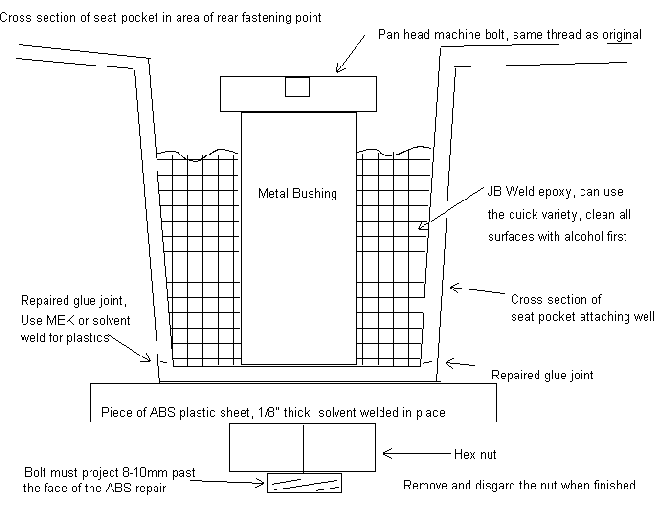
Seat Pocket Mount Repair. [Tips from Bill VanOrden] To repair the plastic side pocket at the base of your seat -which tends to break at the mounting points- you will need:
- Solvent alcohol
- JB Weld Epoxy, fast or slow (Loctite Quick Epoxy can also be used)
- Machine screw approximately 19mm long, same diameter and pitch as the original attaching bolt, see drawing to determine length.
- Nut to fit the above bolt
- Metal bushing or piece of copper tubing to fit the above bolt, about 8-10mm shorter than the bolt. Length is not critical as long as it does not project out of the well in the pocket. Use the drawing for reference.
- Solvent weld or MEK to repair pocket
- Small piece of 3/32" to 1/8" thick ABS plastic sheet
Remove the seat pocket from the car and clean the area around the broken mount with solvent alcohol. If you use isopropyl from the drug store make sure it has no oils in it, many times rubbing alcohol has mineral oil added to it and this defeats its use as a cleaner. Remove and clean the part of the pocket still attached to the seat. Re- attach this to the seat pocket using solvent weld, do NOT glue!! The trick to solvent welding is to get both pieces very clean and hold them together. Then touch a modeler's paint brush wet with solvent to the joint. If you have enough (but NOT too much) solvent on the brush it will wick into the joint and very soon a small bead of plastic will ooze out of the joint. If you have too much solvent on the brush it will run all over and mar the surface of the plastic. This technique can be used to repair cracks in most of the 740 interior panels, I have about a 1/2 pint in my car already! Set aside for 1/2 hour. Weld (using your now perfected solvent welding skills) the small piece of plastic sheet into place. Set aside again for 1/2 hour. Drill the hole in the attaching well through the newly attached piece of plastic. Scuff the outside of the bushing with sandpaper or a file to make the epoxy adhere to it. Bolt this bushing into place using the nut and bolt. The length of the bolt has to allow it to project about 7mm out of the repaired seat pocket and the length of the bushing is such that the head of the bolt is still below the surface of the well opening. See the diagram! Carefully mix the epoxy and pour it around the bushing and fill to almost the top of the bushing. Do NOT fill past the bushing!! Set this whole mess aside in such a way that the epoxy is even and level in the opening, watch it for a minute or so to make sure you have it setting level. When fully set up (overnight in warm area even if you used fast set epoxy) remove the nut and install using the bolt used to hold the bushing into place.
More Headroom Via Lower Seat Cushion.
[Inquiry:] I'm suffering from a lack of headroom in my '88 760. I've heard of a TSB about lowering the front seats to gain about 1" to 1.5". My local dealer does not know about it. Can anyone help me identify it, or even better, tell me what it says and whether it's a DIY kind of job?
[Response: Paul Wright] Volvo service bulletin for US and Canada markets TP 31127/1 (English); 09/88; Body Interior, states that From model year 1991, the seat frame springs can be lowered approx. 10-15 mm (about 1/2 inch) to provide increased headroom. The drawing on the service bulletin shows that there are two sets of mounting holes in the seat bottom frame, where the six springs under the cushion hook into the seat frame. The bulletin suggests hooking the springs into the lower series of six holes. I believe there is only one set of mounting holes cut into the pre-1991 seat bottom frames, but it should be possible to drill out some new ones about 1/2" lower, and get the same headroom advantage as is already available on the post-1991 seats.
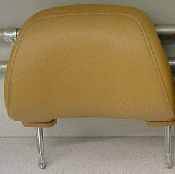
Front Headrest Removal.
[Note 1:]It's a game of blind-man-buff... there is actually a hook/latch holding the two rods.. you have to press down firmly at the back of the seat about 6 inches below the top of the back to release them.
[Andrew] Just below the headrest on the back - just where the fabric can be pressed in -toward one side (about three-four inches from the side edge) I found/felt a wire lever (seemed to have a small loop/circle at the end). It was horizontal mainly - from the side. Worked my fingers and pressed it - released the headrest.It does require some pressure.
[Jay Simkin] As you face the back of the seat, you will see there is a rear seat pocket. About nine inches above the top edge of the seat pocket, there is a line of stitching, which runs from right to left, about 5" below the top of the seat (there are also lines of stitching, that run down towards the top edge of the seat pocket). About one inch above the top line of stitching, there is an angled area, where the fabric is stretched, so that the central part of the seatback forms a recessed panel. About 1.5" above the top line of stitching, you will feel - when you press gently forward (i.e., as if you were going to press your finger through the seat, to the front surface [that closest to the steering wheel]) the edge of a frame. Using your index finger, press gently but firmly forward, directly below where the foot of the headrest joins the seat, right below the frame and about 1 1/2" to the inside of the angled seam. When you have pressed your index finger 1 - 1 1/2" forward, you should feel something springy. It will move forward, as you press on it. This is the headrest catch release lever. The front edge of the steel headrest post has a notch in it. The headrest catch locks into that notch. When you press forward on the headrest catch release lever, you disengage the catch from the notch. It is sometimes helpful to push down on the headrest, push the headrest catch release lever forward, and then pull up on the headrest, to disengage the headrest catch from its notch on the headrest post. You should free each side of the headrest, by lifting each side 1/2", before trying to pull the headrest out of the seat. To re-install the headrest, simply align the posts with the holes, and push the headrest downwards. It will automatically lock into place. [Dave Richards] Sit in the rear seat with a piece of timber about 25mm thick by 75mm wide and 1.5metres long
pushed thru the gap between top of seat and bottom of head rest. Place a towel and a piece of timber on dash for
protection. Rest end of wood through seat on top of packing on dash, then put your shoulder under other end and provide upwards pressure while pushing on seat back with knuckles or thumbs slightly to the outside of each headrest tube
and about 80mm down from top of seat. The actual lock is a cut and pressed whistle notch 3mm deep in the 12mm diameter tubes; the notches are facing the windscreen.
lever, you disengage the catch from the notch. It is sometimes helpful to push down on the headrest, push the headrest catch release lever forward, and then pull up on the headrest, to disengage the headrest catch from its notch on the headrest post. You should free each side of the headrest, by lifting each side 1/2", before trying to pull the headrest out of the seat. To re-install the headrest, simply align the posts with the holes, and push the headrest downwards. It will automatically lock into place. [Dave Richards] Sit in the rear seat with a piece of timber about 25mm thick by 75mm wide and 1.5metres long
pushed thru the gap between top of seat and bottom of head rest. Place a towel and a piece of timber on dash for
protection. Rest end of wood through seat on top of packing on dash, then put your shoulder under other end and provide upwards pressure while pushing on seat back with knuckles or thumbs slightly to the outside of each headrest tube
and about 80mm down from top of seat. The actual lock is a cut and pressed whistle notch 3mm deep in the 12mm diameter tubes; the notches are facing the windscreen.
Sedan/Saloon Rear Headrest Removal. First remove the rear seat back. The headrests are accessible once the seat back comes out.
Wagon/Estate Rear Headrest Removal.
[Jay Simkin] Begin by setting out the terms of reference, so that you can quickly identify the items, to which I refer. 940/960 wagon back seats have a small section (on the passenger side of the car, US/Canada models; driver side of the car, UK/Japan and similar models) and a large section. The small section has a single headrest. The large section has an outer headrest (closest to the door) and an inner headrest (in the center of the car, next to the inner edge of the small section). The large section's inner headrest is part of the infant booster seat. I presume you want to remove the outer headrests, i.e., those closest to the rear doors, rather than the headrest of the infant booster seat.
- (a) Using the flexible vinyl loops, release the catch for each lower seat section and rotate it upwards and forwards, so that the seating surface is against the back of the front passenger seats.
- (b) Using the release lever on the outer upper corner of the each seat back section, press the lever rearwards (towards the back of the car) and release the seat back. Push the seat back forwards and downwards, so that the rearward-facing surface of the seat ends up flat, and facing the roof of the car.
- (c) Lift the flat, rectangular carpeted panels, immediately behind the seat sections. There is slight spring tension on them.
- (d) Immediately in front of the hinge, for the flat rectangular panels noted in (c), above, you will see a 10mm hex nut, that holds to the floor, a black plastic anchor. This anchor is attached to a galvanized metal section, that goes up into the seat back. This galvanized section is part of the mechanism, that pulls down the headrest, so that the top edge of the headrest is flush with the top of the seat back, when the seat back section is pushed forward. (If this were not done, a protruding headrest would stop the seat back section from rotating fully forward, thus preventing the creation of a flat floor in the load space)
- (e) Remove this 10mm hex nut (using a 6" extension bar and a ratchet handle will speed this work). There is no spring tension on this hex nut. Remove the black plastic anchor from the stud (which stud is welded to the car's floor). Replace the hex nut on the stud (to keep the hex nut from getting lost).
- (f) Gently grip the galvanized section and rotate it 45 degrees (in either direction). Pull gently on it - rearwards - until it comes free of the headrest post. With the seatback full forward, you will have room to remove the galvanized section and the plastic tube attached to it. Do not remove the wire springs from this mechanism.
- (g) Set aside the galvanized section. Rotate the seat back section rearwards and so upwards, by about 45 degrees. Firmly grasp the headrest and slowly pull it out of the seat. Take the galvanized section and place it on the longer of the headrest posts. Slide it on at a 45 degree angle, and then rotate it, to lock it into position on the headrest shaft (this will keep the galvanized section from getting lost, and ensure you can replace the headrests easily, when you no longer need to the booster seats).
- (h) Place the headrest units in a plastic bag, and store in a cool, dry place. This will prevent mildew from damaging the fabric/leather, and keep the foam cushioning from drying out
Seat Covers:
Vinyl Repair. I found that a clear PVC solvent adhesive does a real functional job on repairing tears in vinyl upholstery. It's sold in tubes at Walmart for $3. Called Tear Repair. Call 800 248-Poxy
[Inquiry:] The carpool has taken its toll on the mothership (wife drives the car). What is a good option to get the front seats recovered, as the local guy says that he only has vinyl (yuk). or do i have to buy the whole seat from the junkman? New leather covers are available from the dealer at about 1300 bucks for each seat.
[Response:] I had a '90 760 wagon with ruined seats as well. Instead of doing the dealer rape, I took it to a local auto upholstery shop. They took a good look at what needed to be done, and suggested they replace the panels in the seats that were either worn, cracked or torn. They replaced the panels, and then redyed the whole seat to its original color. This was done to both front seats, and the dye was put on the whole interior. They also put in a brand new headliner for me, and fixed a few nick nicks around the interior. The whole job cost me $500. I think that might work for you instead of bending over at the dealer.
[Response 2:] The driver's seat on my '92 940 has some cracking in the leather so I took it to a local upholstery shop that is well respected around here. As we discussed the options for proper repair, he told me he gets all his replacement leather from a supplier who dyes the leather to match what's already in the car--He clips a small sample from under the seat to use for color match. This upholstery shop then sews up the replacements.
[Tip from Gennaro Lopez] I've taken off many a 240 seat and repaired the upholstery (shoe repair shop does wonders with the leather). Now I'm gonna tackle the wife's 740 sedan. Passenger's seat has a rip in the middle of the seat. If I can remove the leather skin, I'll take it to Guiseppo at the shoe repair place and he'll sew a thin piece of leather to it for about $5.
Seat Cushion and Skin Removal.
[Inquiry:] Are the methods for removing the seat & seat skins similar between the 740 and the 240? Any hints to avoid trouble?
[Response: Bob] There is a bar going through the upholstery front and rear, similar to 240. You should remove the seat pocket- 1 screw on rear, spring loaded retainer on front. Looking from under pocket, you will see a hole with a spring and round plastic thing. Stick a screwdriver in and press the retainer toward the seat, and gently jiggle the pocket upward. Then you will find a steel hook about 4-6 inches from the front of the seat cushion. Push the hook toward the center of the seat and unhook from seat frame. Pretty straight forward. I usually leave seat bolted down. However, if you decide to remove it, after unbolting all 4 corners. you have to slide seat back a bit and then lift. There are slots in the floor with holes (key shaped). Not too difficult.
Color Issues.
If you have color problems due to scratches, etc., try a local art supply store and look for those solvent-based permanent art markers that come in a myriad of colors. There is usually a good match in color to be found (although watch color density: the lighter densities work better). Use the marker to color in the scratches, etc. and reduce the color contrast. If you need to re-dye areas of the seats, the dye used in detail shops is from Fitzgerald's (http://www.fitzgeraldsrestoration.com/)and they can be reached at 800 582 3326. The seats do look good. Of course I'm still going to get some Lexol and treat them to keep them looking good.
[Tip] Here's a commercial site with a great deal of useful information about leather repair: http://www.leathermagic.com/
[Tip from John Acampora] All of the guys on my Mercedes list swear by Leatherique http://www.leatherique.com. They have stuff to repair cracked dashes and re-dye/maintain leather.
[Editor:] I rebuilt three seats with the Leatherique products, including leather fill for cracks, Rejuvenator Oil, Pristine Clean, and custom-matched dye (send a small swatch cut from the matching vinyl beneath the seat). The results were spectacular. The total cost for all the seats in my 940 was $120 and I had extra product left over.
[Tip from Dick] You should contact Marathon Seat Covers. They make fabulous seat covers and at reasonable prices. Even can get different grades at different prices. Have used them for years. Can get them at 800 735 2769 or they have a web site which is http://www.marathonseatcovers.com Have used their 200 and 700 series covers and the fit couldn't be better, they look like original equipment even with a klutz like me mounting them
How do I fix the map pockets on the back of the front seats. The elastic bands are completely stretched out so that the pockets do not rest agains the seat?
[Response: Bruce S.] I bought elastic strips from a craft store. I then cut small slits across the channel that holds the old elastic inside the the map pocket, about 2 inches from each corner. Cut the old elastic, but leave enough of a stub to work with on each side. Now using small safety pins, pin the new elastic to one of the old stubs. Now pin the other end to the old piece and use it to pull the new through the channel. Now experiment with how tight to pull the new, and safety pin it to the other stub and cut off the extra. Then push everything back through the small slits and its as good as new with only the small slits on the inside of the pocket. I think I used a single edge razor blade to cut the slits.
Cleaning Seat Covers. [Editor] Leather Covers: Use a gentle leather cleaner made for auto seats (Leatherique has a very good system) and clean them while the skins are mounted on the foam cushions. Air dry. Cloth Covers: You can remove the cloth covers and launder them. The upholstery material is 100% polyester, and you won't hurt it by machine wash gentle and light drying. Remove all metal hardware (rods, rings, etc.). Pre-treat any spots with concentrated detergent, then by soaking in cold water in a sink with any detergent. Then wash in a machine on the cold, gentle cycle. Air dry only; do not use a dryer! Reassemble using heavy duty zip ties in place of hog rings.
Upgrade:
Wagon/Estate Third Seat Installation. See the scanned OEM manual instructions thanks to Kris Carlson.
Installing Power Seats in a Manual Seat Car. See Jay Simkin's discussion for complete instructions.